


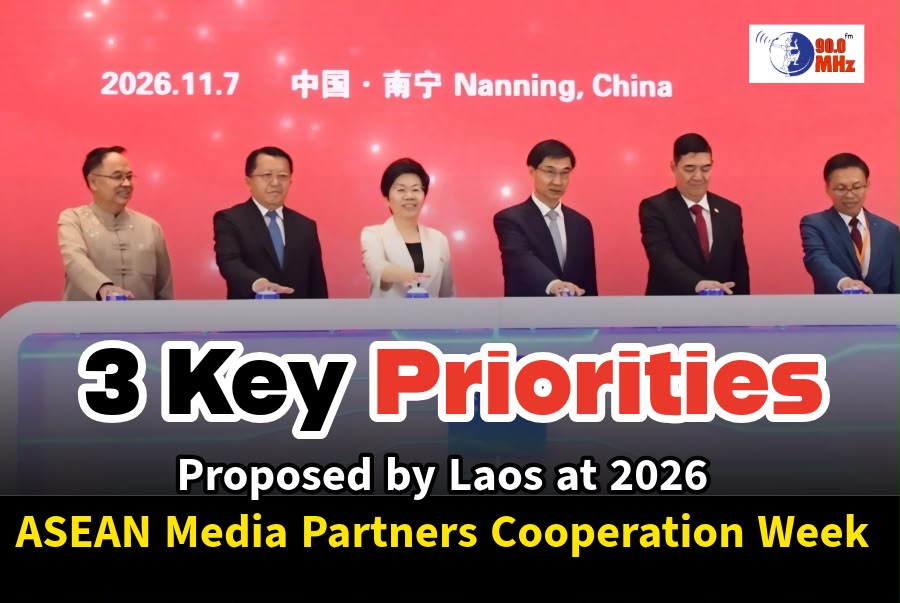
NANNING, China — The 2026 ASEAN Media Partners Cooperation Week officially kicked off on November 7 in Nanning, the capital of South China’s Guangxi Zhuang Autonomous Region. The event drew approximately 200 delegates, including representatives from Chinese and ASEAN media regulatory bodies and organizations, along with journalists from nine countries. The gathering serves as a vital platform for networking, sharing experiences, and fostering cooperation amidst the ongoing digital transformation.
Speaking at the milestone event, Mr. Vansy Kuamoua, Deputy Head of the Propaganda and Training Board of the Lao People’s Revolutionary Party Central Committee, addressed the forum on behalf of the Lao PDR. He expressed his sincere gratitude to the China Media Group (CMG), Chinese media leaders, and the Guangxi Zhuang Autonomous Region for their warm hospitality. He highlighted that 2026 is a highly significant year, marking the 35th anniversary of China-ASEAN dialogue relations and the 5th anniversary of their comprehensive strategic partnership. For Laos in particular, Mr. Vansy noted, China remains a close neighbor and a vital strategic partner that has provided continuous support.

Furthermore, Mr. Vansy proposed three key priorities to guide China-ASEAN media cooperation: enhancing professional capacity building, fostering joint content production and cultural exchanges, and building inclusive partnerships to ensure equitable access to technology. He noted that the event’s theme—”Artificial Intelligence, Connectivity, Shared Future”, reflects a collective commitment to leveraging technological innovation for regional solidarity and peaceful development.

Meanwhile, Qi Zhuquan, Member of the Party Leadership Group and Vice President of China Media Group (CMG), reiterated China’s dedication during his address. “As the largest comprehensive international media organization. CMG will continue to leverage its international communication advantages, which include broadcasting in 85 languages, the CGTN integrated media platform, and 192 overseas bureaus,” Qi stated. He emphasized plans to deepen collaboration with Southeast Asian media across program co-production, personnel exchanges, technology sharing, and joint event planning “to help build an even closer China-ASEAN community with a shared future.”

A major highlight of the opening ceremony was the official launch of the “China-ASEAN Digital Media and Artificial Intelligence Innovation Report.” The publication analyzes the opportunities and challenges presented by digital technologies, particularly artificial intelligence (AI). It underscores how AI is profoundly transforming the production, distribution, and consumption of information, thereby urging media organizations to accelerate their innovation efforts.
This year’s ASEAN Media Partners Cooperation Week serves as more than just a platform for sharing experiences; it reaffirms the critical importance of media connectivity in the digital age. Effective media collaboration is expected to make a substantial contribution to enhancing mutual understanding, strengthening people-to-people ties, and building a robust social foundation for sustainable regional cooperation.
